
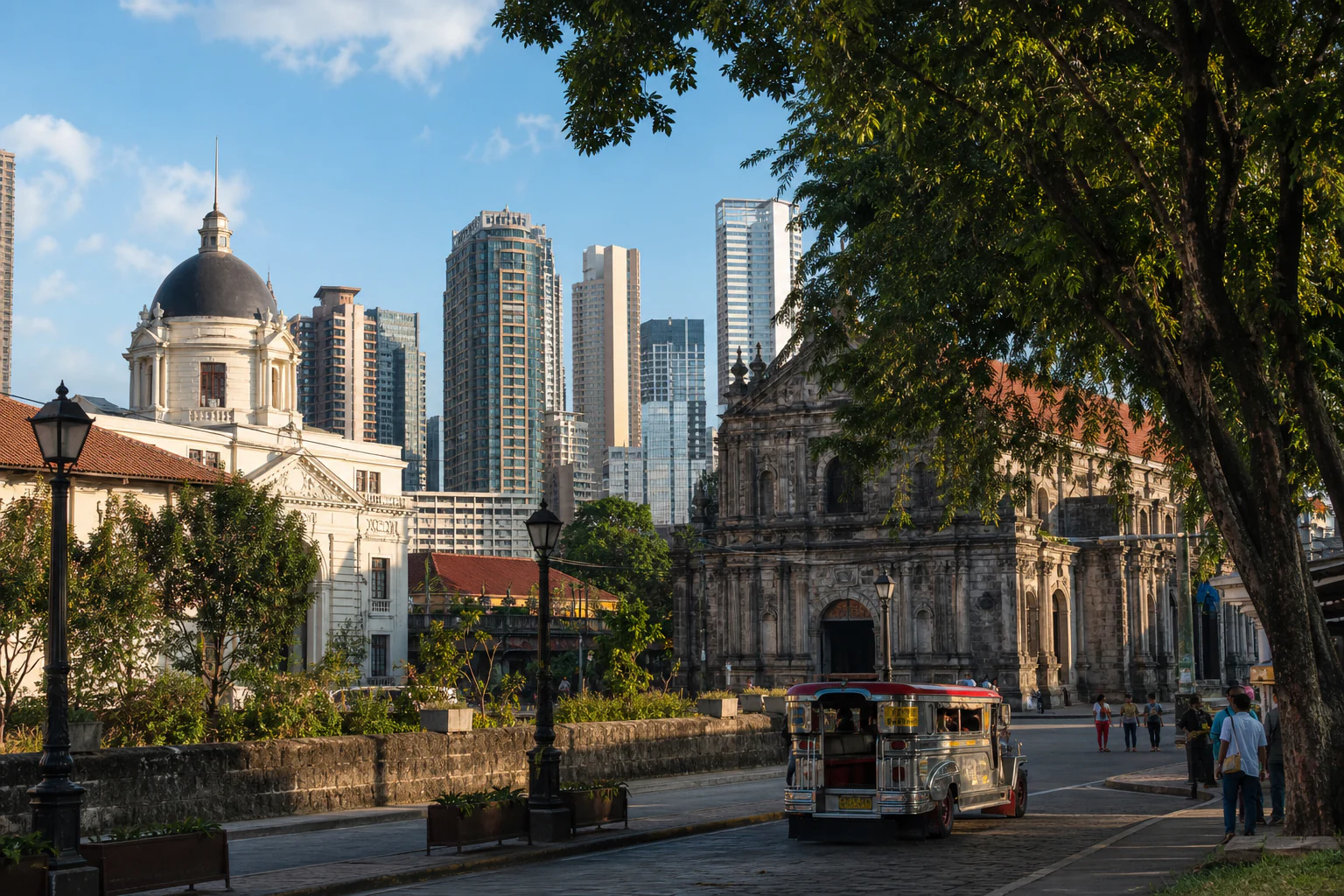
Manila
The Philippines' economic engine: English-first, energetic and exhausting in equal measure.
Philippines › Manila
Digimad score
7.6
Very good
Best for English + Business + Healthcare
About
Metro Manila is not one city so much as a federation of business districts, residential enclaves and older centres welded together by traffic. Its case for remote workers is practical: English is universal, the country contains its best hospitals and deepest professional network, direct flights reach the whole region, and Makati or BGC can provide a very comfortable apartment-and-coworking life. Outside those bubbles the metropolis becomes noisier, hotter and harder to navigate, while flood-prone roads and rush-hour journeys make proximity more valuable than square metres. Food, nightlife and local creative culture are excellent, and Filipinos make social integration unusually easy. Manila works for people who need connectivity, healthcare and a serious business scene; it is a poor choice for anyone expecting a calm, walkable Southeast Asian capital.
Manila at a glance
Internet
150 Mbps median fixed, good reliability
Monthly budget
$1,950/mo comfortable, $1,050 lean
Best months
Jan, Feb, Mar
Community
Medium nomad density, excellent English
Key points
English is universal across work, healthcare, housing and daily services
The country's deepest startup, outsourcing and professional network
BGC and Makati provide dense clusters of condos, offices, gyms and restaurants
St Luke's, Makati Medical Center and The Medical City offer top-tier private care
A major air hub for reaching the Philippines' islands and the wider region
Neighbourhoods
Makati is the best all-round base: Legazpi and Salcedo villages are leafy, walkable pockets around the business district, while Poblacion adds dense nightlife and more noise. Bonifacio Global City in Taguig is newer, cleaner and easier to navigate on foot, with the best pavements and premium hospitals, but it feels planned and costs the most. Ortigas sits between the major centres and offers better-value condos around a strong office cluster. Quezon City is vast and more local; Tomas Morato and Eastwood have restaurants, nightlife and apartments but place you far from Makati. Ermita and Malate put old Manila, the bay and museums nearby, yet infrastructure and street conditions vary block by block. Choose around your daily routine: crossing the metropolis for work or friends is the mistake newcomers make once.
Cost of living
USD
Lean
$1,050/mo
Shared housing, local food
Comfortable
$1,950/mo
Private one-bed, coworking
Premium
$3,600/mo
Central, frequent dining
Local currency
PHP
Housing
- Studio
- $480
- 1-bed centre
- $760
- 1-bed outside
- $400
- Coliving room
- $480
- Airbnb monthly
- $1,150
Everyday costs
- Local meal
- $3
- Mid-range meal
- $18
- Coffee
- $4
- Groceries/mo
- $300
- Coworking day
- $12
- Hot desk/mo
- $180
- Private desk/mo
- $350
- Transit pass
- $30
- Short ride
- $5
- Scooter/mo
- $85
- Gym/mo
- $55
Local food and services remain inexpensive, but a modern one-bedroom in BGC or central Makati can cost twice its Cebu equivalent. Living near your daily destinations is worth paying for because cheaper rent across town is often erased by transport time.
Internet & connectivity
Fixed line
150 Mbps
Mobile
38 Mbps
Data plan
$14/mo
eSIM
Supported
Reliability
GoodPublic Wi-Fi
FairPower stability
GoodPLDT, Globe and Converge fibre can all deliver fast service in newer towers, but building exclusivity and congested local lines create sharp address-by-address differences. Verify the installed provider, actual speed and generator coverage before signing, and keep a second-network mobile hotspot.
Nomad community
Nomad density
MediumEnglish
ExcellentCoworking spaces
KMC Solutions
$190/mo
Makati and BGC
Acceler8
$165/mo
Makati
The Company Manila
$175/mo
Makati
Languages spoken
Meeting people
The startup, creative and outsourcing sectors produce a deep calendar of professional events, while language is no barrier to local friendships. The scene is distributed between Makati, BGC, Ortigas and Quezon City rather than concentrated in one nomad neighbourhood.
Manila is one of the easiest Asian capitals in which to build a mixed local and international network. The logistical challenge is arranging social life so that people are not crossing the city at peak hour.
Safety
Emergency 911
At night
FairSolo female
FairPetty crime
FairCommon scams
Phone and bag theft in crowded transport
Taxi drivers refusing the meter or claiming a broken meter
ATM skimming at unattended machines
Distraction and confidence scams in tourist districts
Women travellers
BGC, the Makati business district and busy mall areas are comfortable with normal precautions. Use Grab after dark and avoid isolated streets or unfamiliar transport interchanges alone.
LGBTQ+
Manila has one of Asia's most visible LGBTQ communities and a broad social acceptance in central districts, although national legal protections remain incomplete.
Safety changes quickly by district. Affluent business centres are heavily guarded, while theft and street harassment are more plausible in crowded older areas. Typhoons, flooding and road safety are material risks too.
Healthcare
Consultation
$35
Pharmacies
ExcellentPublic system
Public hospitals are overstretched and foreign residents normally use private care.
Private care
Manila contains the Philippines' best-equipped hospitals, English-speaking specialists and widest range of complex care. Private prices remain low by US standards but major admissions require insurance or a substantial deposit.
Insurance
Carry private cover with direct billing at your preferred hospital. Metro Manila reduces the need for domestic evacuation, but repatriation and coverage elsewhere in the archipelago still matter.
Getting around
Walkability
FairPublic transport
PoorAirports
- MNLNinoy Aquino International35 min
The LRT and MRT are useful on their corridors but crowded and incomplete for a metropolis this size. Grab is the default car service; Angkas, JoyRide and Move It motorbike taxis are far faster in traffic. Airport travel can take twenty minutes or two hours, so leave a large margin.
Climate & seasons
32°C / 25°C
Tropical monsoon
Rainy season
June to November, with the highest flooding and typhoon disruption usually from July to October
Air quality
Traffic and regional pollution regularly produce poor air in dense corridors; conditions improve after rain and near the bay.
December to February is drier and less oppressive. April and May are extremely hot, then the south-west monsoon brings heavy rain, humidity and recurrent street flooding.
All ratings
Watch out for
Traffic can turn a short cross-city journey into a two-hour commitment
Air pollution, heat, noise and seasonal flooding wear people down
Fibre quality depends on the exact building and backup power is not universal
Comfortable central housing costs far more than elsewhere in the Philippines