
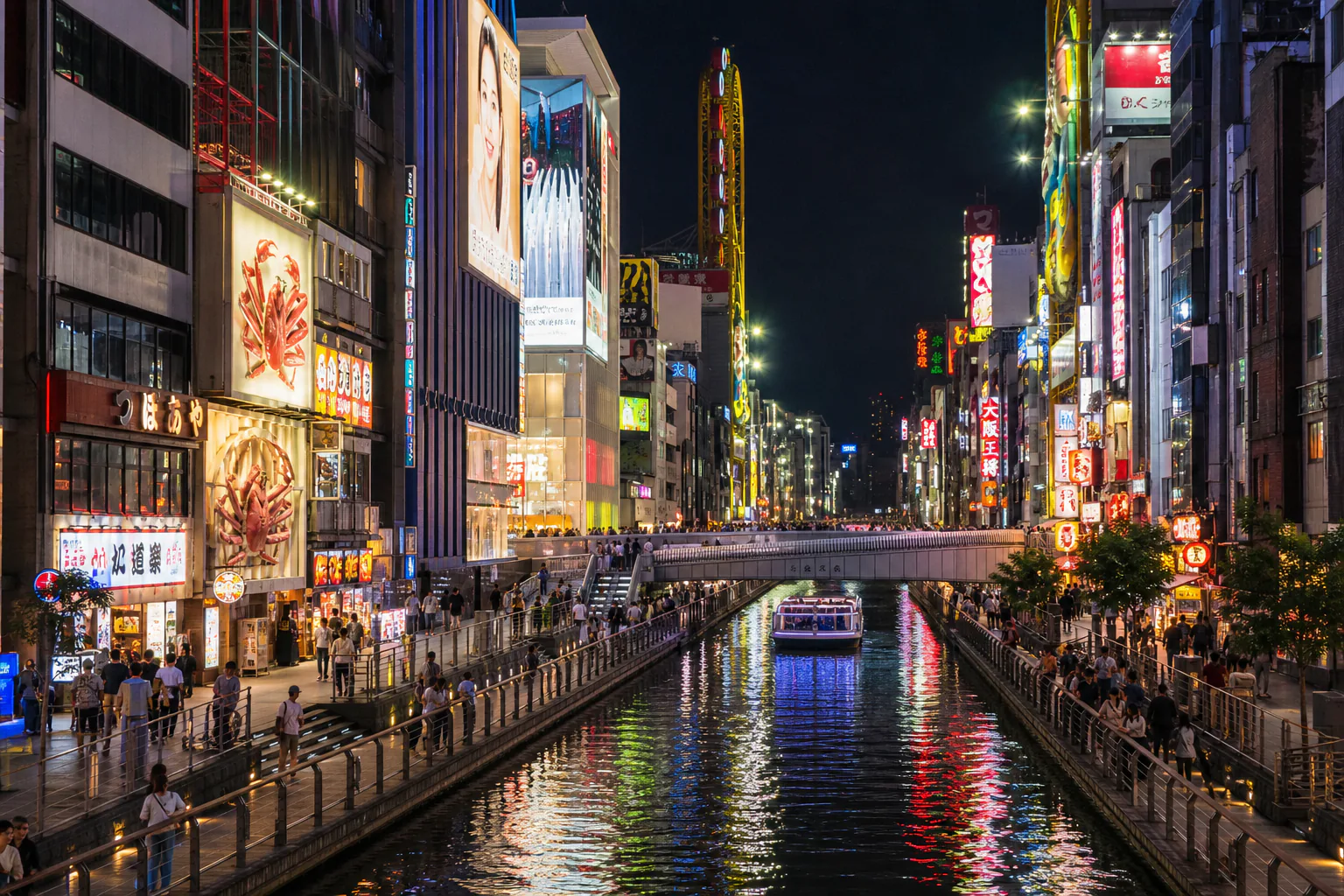
Osaka
Tokyo's infrastructure at 70% of the price, with better food and looser manners.
Japan › Osaka
Digimad score
8.5
Excellent
Best for Food + Value + Transit
About
Osaka is the practical choice for anyone who wants Japan without Tokyo's rents. The transit network is nearly as good, the city is compact enough to cross in twenty minutes, and the food culture is the country's most enthusiastic, built on standing bars and street food rather than reservations. Osakans are noticeably more direct and informal than Tokyoites, which most foreigners find easier. Kyoto is fifteen minutes away by train and Kobe twenty, so a base here covers the whole Kansai region. The trade-off is a smaller international community, less English, and summers that are hotter and stickier than Tokyo's because the city sits in a basin.
Osaka at a glance
Internet
220 Mbps median fixed, excellent reliability
Monthly budget
$2,100/mo comfortable, $1,250 lean
Best months
Apr, May, Oct, Nov
Community
Low nomad density, poor English
Key points
Rent runs roughly 30% below Tokyo for the same standard
Kyoto, Nara and Kobe are all under 30 minutes by train
Compact enough to cross the centre in 20 minutes on the loop line
The best casual eating in Japan, built on standing bars and street food
Kansai International connects widely across Asia at low cost
Neighbourhoods
Chuo ward around Namba and Shinsaibashi is the centre: dense, loud, and full of food, though the tourist crush around Dotonbori is heavy. Kita around Umeda is the business and shopping core, cleaner and more corporate, with the best transit access. Nakazakicho just north of Umeda is the pocket of old houses, small cafes and vintage shops where creative types live. Fukushima and Nishinari sit at opposite ends of the desirability scale, the first quietly excellent for food, the second the cheapest area in urban Japan with a reputation to match.
Cost of living
USD
Lean
$1,250/mo
Shared housing, local food
Comfortable
$2,100/mo
Private one-bed, coworking
Premium
$3,600/mo
Central, frequent dining
Local currency
JPY
Housing
- Studio
- $520
- 1-bed centre
- $800
- 1-bed outside
- $500
- Coliving room
- $550
- Airbnb monthly
- $1,150
Everyday costs
- Local meal
- $6
- Mid-range meal
- $18
- Coffee
- $4
- Groceries/mo
- $340
- Coworking day
- $16
- Hot desk/mo
- $165
- Private desk/mo
- $320
- Transit pass
- $55
- Short ride
- $11
- Scooter/mo
- $0
- Gym/mo
- $55
The clearest value in urban Japan. A lunch set is USD 6, the subway is USD 1.50, and a central one-bedroom costs less than a studio in Tokyo.
Internet & connectivity
Fixed line
220 Mbps
Mobile
85 Mbps
Data plan
$25/mo
eSIM
Supported
Reliability
ExcellentPublic Wi-Fi
FairPower stability
ExcellentFibre is excellent but requires residency and weeks of lead time. Most short-stayers use pocket Wi-Fi or an eSIM. Cafe Wi-Fi is less consistent than in Korea or Taiwan.
Nomad community
Nomad density
LowEnglish
PoorCoworking spaces
Billage Osaka
$160/mo
Umeda
WeWork Namba SkyO
$260/mo
Namba
The DECK
$140/mo
Chuo
Languages spoken
Meeting people
The foreign community is mostly teachers and long-term expats. International meetups exist but are small; language exchanges are the easiest entry point.
Osakans are famously more approachable than Tokyoites, which offsets some of the language barrier.
Safety
Emergency 110 (police), 119 (fire and ambulance)
At night
ExcellentSolo female
ExcellentPetty crime
ExcellentCommon scams
Bar touts in Kita-Shinchi and Namba leading to inflated tabs
Unlisted cover charges at izakaya
Women travellers
Extremely safe. Women-only train carriages operate at peak hours.
LGBTQ+
Doyamacho is Osaka's established scene. Socially tolerant, with no national marriage recognition.
Osaka has slightly higher petty crime than Tokyo, which still makes it safer than almost any Western city. Earthquake preparedness is the real consideration.
Healthcare
Consultation
$50
Pharmacies
ExcellentPublic system
National Health Insurance requires residency registration, which the digital nomad visa does not provide.
Private care
Care quality is high and moderately priced, though English-speaking clinics are fewer than in Tokyo.
Insurance
Without residency you pay full cost, so carry a policy. Confirm it covers Japan at reasonable limits; hospital stays here are not cheap.
Getting around
Walkability
ExcellentPublic transport
ExcellentAirports
- KIXKansai International50 min
- ITMOsaka Itami30 min
The Midosuji subway line and the JR Osaka Loop cover almost everything. An ICOCA card works nationwide. The city is flat and compact, so cycling is popular and practical.
Climate & seasons
21°C / 12°C
Humid subtropical
Rainy season
Tsuyu in June and early July, typhoon risk August to September
Air quality
Good. Spring cedar pollen affects many people.
Spring and autumn are excellent. August in the Osaka basin is genuinely oppressive, worse than Tokyo.
All ratings
Watch out for
Less English than Tokyo, and fewer English-speaking services
Summer in the basin is hotter and more humid than Tokyo
Smaller international and startup community
Short-term furnished rentals are less abundant than in Tokyo